
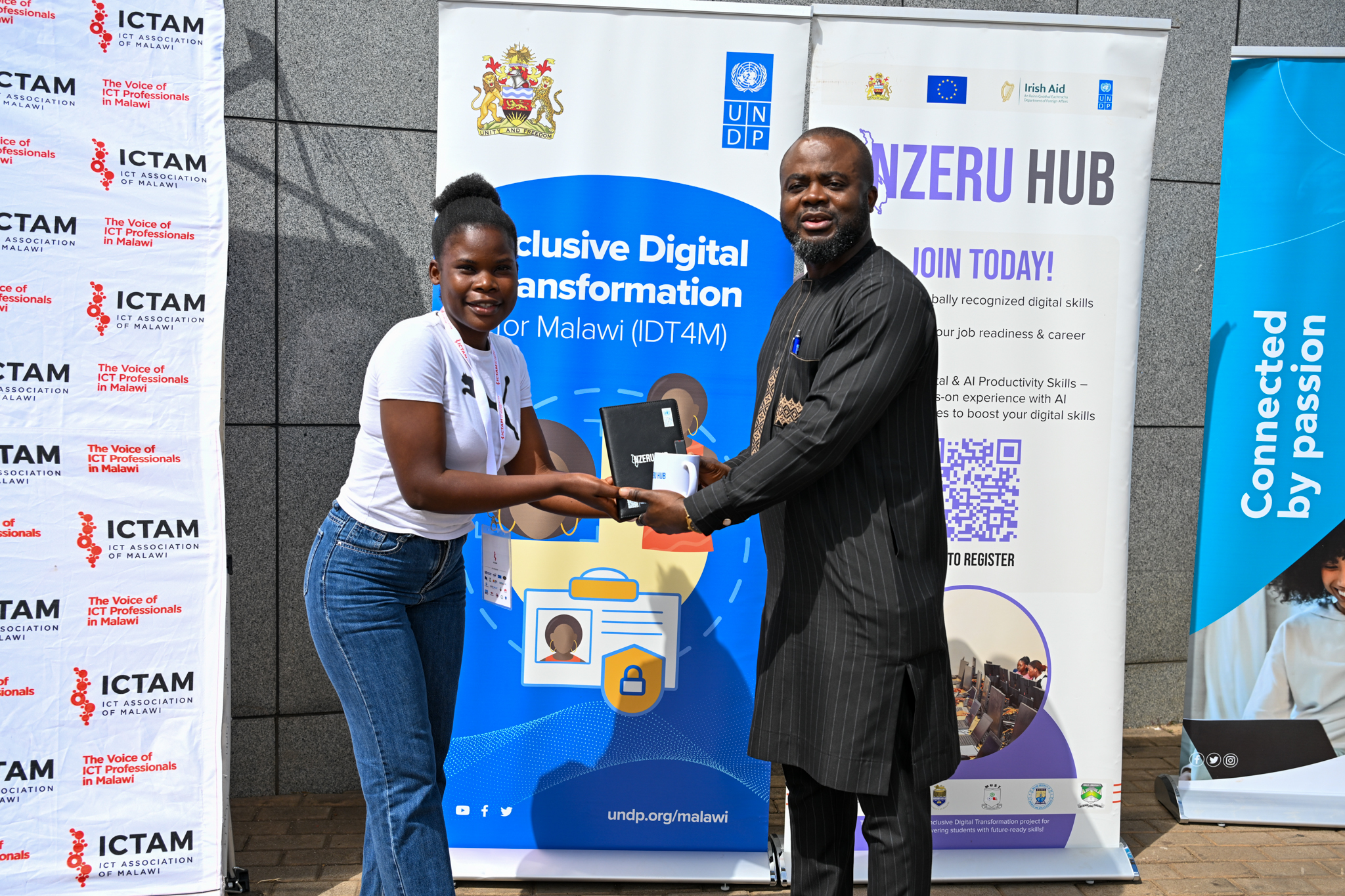
Malawi is investing in the digital skills of its young people through Nzeru Hub, a free, inclusive digital learning platform developed by UNDP Malawi in partnership with the ICT Association of Malawi (ICTAM) with funding from the European Union, the Government of Norway and Irish Aid. By providing internationally recognised courses from Microsoft, Cisco and LinkedIn Learning, the platform is equipping young Malawians with the practical ICT skills needed to thrive in an increasingly digital economy.
The results are already demonstrating the platform's growing impact. In 2026 alone 5,330 students enrolled on the platform, registering for 11,112 courses across a wide range of ICT disciplines, including programming, networking, cybersecurity, artificial intelligence, data analytics and digital entrepreneurship. Nzeru Hub is not only expanding access to digital learning but is also helping close the gender gap in technology. Female participation increased from 29 percent to 32 percent, with the number of female learners enrolled rising from 864 to 1,298. Equally encouraging, female course completion rates improved from 22 percent to 34 percent, with the number of female students successfully completing courses increasing from 25 to 188.
Among the young innovators benefiting from the platform is Annie Kashion, a 22-year-old Bachelor of Science in Computing student at the National College of Information Technology (NACIT). Annie's journey demonstrates how digital skills can be transformed into practical solutions that address real development challenges.
Having successfully completed 48 courses on Nzeru Hub, Annie has strengthened her expertise in computing, cybersecurity, encryption, network security and access control systems. The internationally recognised courses have complemented her university education by giving her practical, industry-relevant skills and the confidence to apply technology to solve community problems.
Inspired by a desire to make technology more inclusive, Annie is developing a mobile application for people who are partially or completely visually impaired. Designed in collaboration with the Malawi Union for the Blind, the application will combine artificial intelligence, GPS technology, voice functionality and multilingual support in both English and Chichewa.
For partially sighted users, the application will improve access to educational and informational resources, while blind users will benefit from GPS-enabled navigation, voice-guided directions and text-to-speech functionality that support independent mobility and access to information. Through voice commands and accessible design, Annie hopes the application will remove barriers that often limit opportunities for people living with visual impairments.
"My goal is to create a tool that empowers people to become more independent and have equal access to information and research opportunities," Annie says. "Technology should be available to everyone, regardless of their physical limitations."
Her vision extends beyond this single innovation. Annie hopes to establish a technology start-up that will create employment opportunities for other young people while developing locally driven digital solutions for Malawi's development challenges. She is also committed to ensuring that her application remains free for those who need it most.
Reflecting on her journey, Annie credits Nzeru Hub with expanding her practical knowledge beyond the classroom.
"The programme has helped me move beyond theory and understand how technology can be used to solve real problems," she explains.
As more young people gain access to high-quality digital learning through Nzeru Hub, stories like Annie's are becoming increasingly common. By building practical ICT capacity, promoting greater participation of women in technology and nurturing innovators who are solving local challenges, Nzeru Hub is helping develop the skilled workforce Malawi needs to drive digital transformation and build an inclusive, knowledge-based economy.